

Nature Medicine · 2019350+ citations
Augmented-reality microscope with real-time AI for cancer diagnosis
First clinical demonstration of a real-time AI overlay during pathologist diagnosis. Co-invented by Dr. Hipp.
Frontier projectCoa · Digital Pathology
A whole-slide viewer, a frontier-model benchmark, and governed clinical AI — led by a pathologist who helped invent the field.
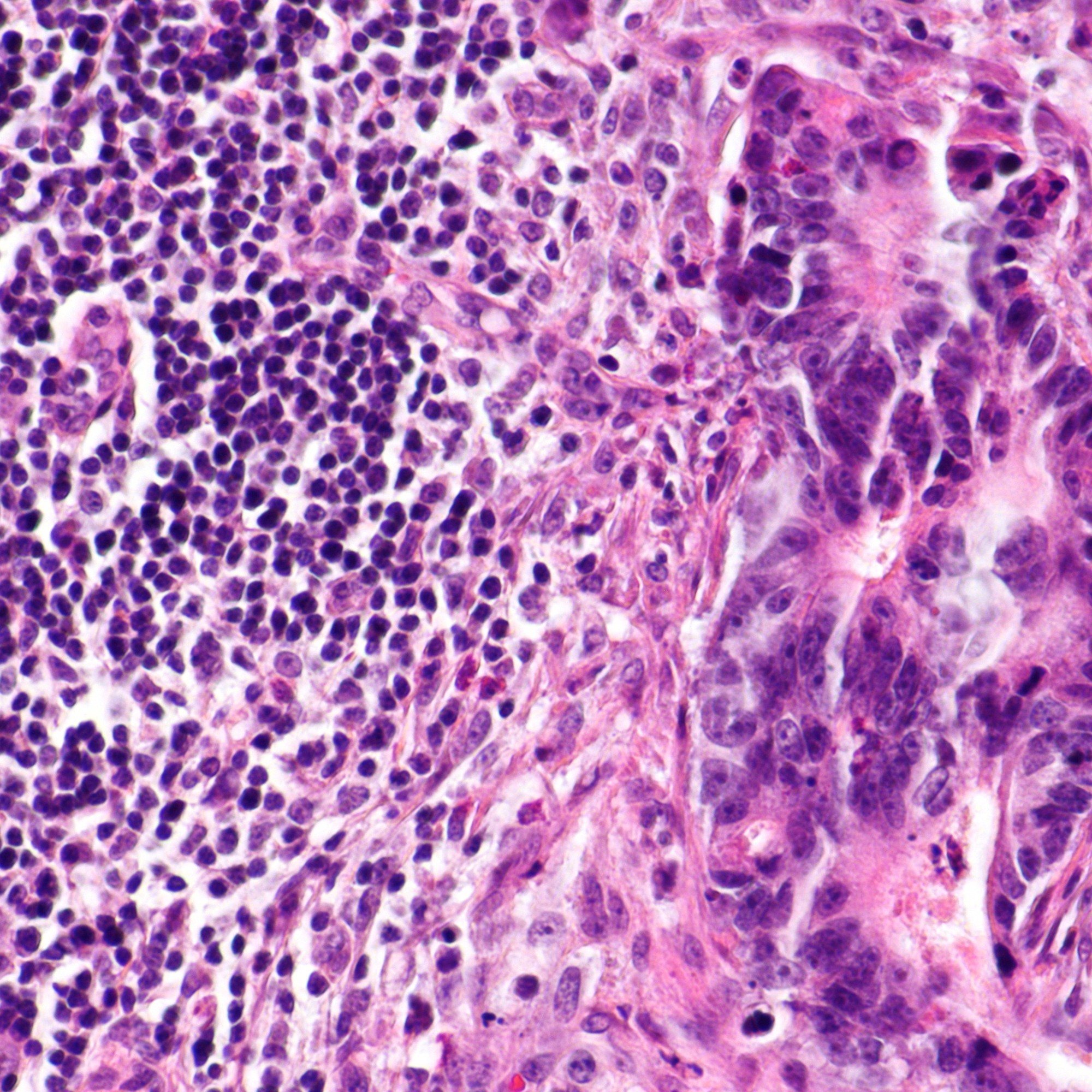
Research imagery — no patient data.
The problem
The answer comes from the slide, and the slide comes to a pathologist already drowning in volume. Demand climbs every year as the workforce shrinks.
US pathologists fell about 17% in a decade. The ones who remain carry more.
More cases, harder cases, rising cancer incidence — demand outruns capacity.
Slides queue and sign-out waits, so the answer a patient needs arrives late.
Whole regions have almost no pathologists — roughly one per million in places.
How we answer it
Three builds, each answering a part of the process — see the slide, trust the model, reason beyond it.
01See the slide
Browser-native deep-zoom, case routing, and an integration surface for FDA-cleared AI — built to sit inside the sign-out a pathologist already runs.
Deep-zoom whole slides in the browser — no install, no plugin, no workstation.
The worklist triaged and routed, so the next slide up is the right one.
A place for FDA-cleared models to overlay their read, grounded to the pixels.
Results land in the LIS and EHR as standard resources, not a separate tool.
Representative interface — product screenshots to follow.
AI belongs in the eyepiece, not the pathologist’s chair. It flags the focus and shows its work — the sign-out stays a human decision.
02Trust the model
A multi-model evaluation viewer runs the same region past the frontier models side by side and scores them against known-answer cases — which reads this stain best, at what confidence, at what cost.
The same region, the same question, every frontier model at once.
Graded against known-answer cases, with agreement and confidence on the record.
Quality and cost per read together, so the right model runs the right task.
The discipline behind every model that reaches a clinical surface.
Representative interface — model labels and scores illustrative.
03Reason beyond it · Coming soon
Pathology-grade interpretation for general medicine: records, labs, and wearable signal synthesized into one read, so there are fewer touchpoints between a question and an answer.
Records, labs, and wearable signal, read together instead of one at a time.
On the record layer clinicians already run, not a data island beside it.
Concept interface — in development with clinical partners.
Built for clinical trust
Grounded, measured, auditable. AI proposes; the pathologist decides. Mapped to NIST AI RMF and OWASP for LLMs.
HL7 FHIR into the LIS and EHR, so a read lands in the workflow, not beside it.
PHI stays inside the tenant. Access scoped and logged; no case content trains a shared model.
The viewer hosts FDA-cleared AI, assistive by design, with the pathologist at sign-out.
Led by a pathologist who helped invent the field
The first pathologist hired onto Google Health’s computational-pathology team, co-inventor of Google’s AR Microscope and its SMILY image search, and founder of a hospital Division of Computational Pathology & AI — the rigor he brought to Mayo, Alphabet, and AstraZeneca, pointed at the slide.

MD/PhD · Board-certified Anatomic Pathology · Wake Forest
Published, patented, and FDA-recognized — three papers that helped define the field
Nature Medicine · 2019350+ citations
First clinical demonstration of a real-time AI overlay during pathologist diagnosis. Co-invented by Dr. Hipp.
npj Digital Medicine · 2019570+ citations
A foundational paper for clinical-grade prostate-cancer pathology AI.
J. of Medical Imaging · 2014FDA + NIH coauthors
A platform for the validation studies clinical AI has to pass — a decade before validation was common.
The methodology generalizes beyond the slide. See clinician-directed AI and nine years of wearable data — a diagnosis in days that four years of visits had missed.